

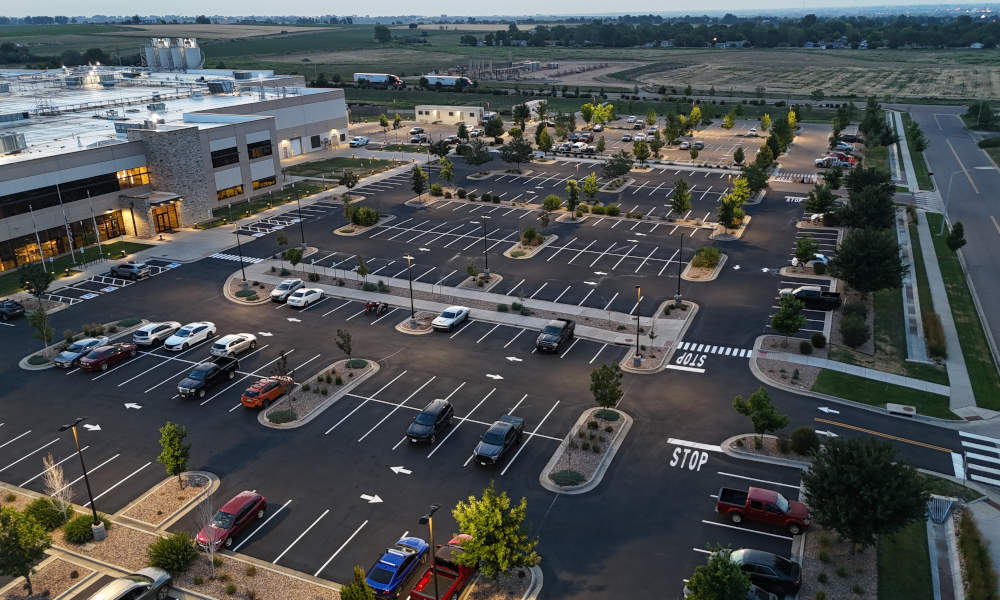
Denver’s soil is the single largest factor in how long your asphalt or concrete lasts. Most of the metro area sits on expansive clay soils loaded with bentonite and montmorillonite, minerals that swell when they take on water and shrink when they dry out. That seasonal movement, not traffic weight, is what cracks and heaves the majority of Front Range driveways and parking lots.
According to the Colorado Geological Survey, expansive soil is the state’s most significant geologic hazard, and swelling soils cause more property damage nationally each year than floods, tornadoes, earthquakes, and hurricanes combined. Pavement is not exempt. A perfectly mixed asphalt lift placed over an untreated clay subgrade will still fail early.
This guide breaks down the soil types you will encounter across the Front Range, what each one does to pavement, and how we adjust our build for them from Denver up through Boulder, Fort Collins, Loveland, and Greeley.
Why Soil Matters More Than the Asphalt Mix
Pavement is a layered structural system, and the subgrade is the layer doing most of the work. Asphalt and concrete distribute load, but the native soil underneath carries it. When that soil moves, the surface has no choice but to move with it.
The Federal Highway Administration classifies a soil as expansive for pavement purposes when it swells more than 3 percent. Large portions of the Denver metro test well above that threshold in an untreated state, which is why local jurisdictions require subgrade remediation before paving.
“We will not lay a mat over a subgrade that has not been addressed, and that is not a preference, it is a condition of the work,” says the Enright Asphalt project team. “A flawless mat over untreated clay is a callback waiting to happen. Most of the failures we get called out to repair started below the pavement, not in it.”
That is also why we treat new construction paving and full-depth asphalt driveway replacement as geotechnical projects first and paving projects second.
The Four Soil Types Under Front Range Pavement
Front Range soils fall into four broad groups: expansive clay, loam and silt loam, cobbly granitic alluvium, and poorly drained floodplain soils. Each one changes the base design, the compaction target, and the drainage plan.
1. Expansive Clay Soil

Expansive clay is the defining soil of the Denver basin. It comes from weathered volcanic ash preserved in the Pierre Shale and Denver Formation, and its dominant mineral is montmorillonite, commonly sold and referred to as bentonite.
Pure bentonite can expand up to 15 times its dry volume when saturated. In natural soil blends the swelling is milder but still destructive, typically producing a volume increase of roughly 25 percent above the dry state. That is more than enough to lift a driveway slab.
Colorado’s climate makes it worse. The metro receives roughly 15 inches of annual precipitation against about 60 inches of snow, so the soil cycles between deep drought and sudden saturation from spring snowmelt, which is the exact wet and dry rhythm that drives heave.
2. Loam and Silt Loam

Loam is a balanced blend of sand, silt, and clay. The USDA-NRCS Fort Collins series, a fine-loamy soil formed in wind-deposited sediment and alluvium, is a textbook example and covers much of northern Larimer County.
Loam compacts predictably and drains at a moderate rate, which makes it the friendliest subgrade we work with. The catch is silt content, because silt-rich soils are frost susceptible and can lift pavement during freeze and thaw even when swell potential is low.
3. Cobbly and Gravelly Granitic Soils

Closer to the foothills, decomposed granite washes out of the canyons and forms coarse alluvial fans. The Nederland series, whose type location is in Boulder County, is a cobbly sandy loam that can run 25 to 30 percent cobbles and another 25 to 30 percent pebbles by volume.
From a drainage standpoint this is excellent material. From a construction standpoint it means rock excavation, harder trenching, and occasional oversize material that has to be screened out before base placement.
4. Alluvial and Poorly Drained Floodplain Soils

Along the Big Thompson, Cache la Poudre, and South Platte corridors you get deep alluvial deposits with shallow groundwater. The NRCS Loveland series is a somewhat poorly drained clay loam that transitions to very gravelly sand around 30 inches and carries visible calcium sulfate crystals.
Sulfates matter for two reasons. They can attack concrete over time, and they can react badly with lime stabilization by forming ettringite, which expands and defeats the purpose of the treatment. Soil testing catches this before it becomes a warranty claim.
What Expansive Soil Actually Does to Pavement
Soil movement shows up as specific, recognizable failure patterns. If you can identify the pattern, you can usually identify the cause.
- Random map cracking across the middle of a slab or mat, caused by differential heave rather than load
- Longitudinal cracks running parallel to the pavement edge where moisture content differs from the center
- Alligator cracking in wheel paths, which signals the base has lost support and the surface is flexing
- Birdbaths and ponding where the subgrade consolidated unevenly after a wet season
- Raised, tented joints and curled concrete panels at driveway aprons and sidewalk transitions
- Rapid crack widening year over year, which almost always means water is now reaching the subgrade
Catching these early is the difference between crack sealing and full asphalt repair. Our guide on repair strategy for aging lots in Denver walks through how we triage each pattern, and how to fix cracks in your concrete driveway covers the residential side.
Soil Conditions by Region: Denver, Boulder, Fort Collins, Loveland, and Greeley

Soil changes noticeably over a 65-mile stretch of the Front Range. Here is how the conditions compare across the areas we pave most often.
| City | Dominant Soil | Primary Risk | How We Adjust |
|---|---|---|---|
| Denver Metro | Expansive clay over Denver Formation and Pierre Shale | High swell, differential heave | Subexcavate and moisture condition, thicker base |
| Boulder | Cobbly granitic alluvium with Pierre Shale clay on slopes | Mixed support within one lot, rock excavation | Zoned subgrade prep, undercut soft pockets |
| Fort Collins | Fort Collins loam and Nunn clay loam | Moderate swell plus frost heave in silt | Standard moisture conditioning, frost-depth base |
| Loveland | Loveland clay loam, shallow groundwater, sulfates | Pumping subgrade, sulfate attack | Underdrains, cement or sulfate-safe stabilizer |
| Greeley | Weld silt loam over loess, sandy soils to the south | Highly variable support across a single site | Additional borings, separation geotextile |
Denver Metro
Denver is the clay capital of the Front Range. Neighborhoods across southeast Denver, Aurora, and the south suburbs sit on concentrated Pierre Shale and Denver Formation deposits, which is why local design manuals require subexcavation and replacement with moisture-conditioned fill.
We see the same conditions running north through Thornton, Westminster, Commerce City, and Brighton. Design assumptions that work in one part of the metro rarely transfer without a soils report.
Boulder
Boulder is the most variable soil environment we work in, and rock is a genuine factor. The city sits where granitic canyon outwash meets the plains, so coarse cobbly alluvium dominates the western side while swelling Pierre Shale clay shows up along the slopes.
Research on the urban geology of Boulder has directly linked swelling clays in the Pierre Shale to pavement heaving and foundation failure. A single commercial lot can straddle both conditions, which is why our Boulder paving scopes often include zoned subgrade treatment. You can see how that played out on our Qualcomm Boulder project and the Courtyard by Marriott Boulder recap.
Nearby foothill communities including Golden, Evergreen, and Morrison share the same coarse and rocky profile.
Fort Collins
Fort Collins is the most forgiving of the five. The NRCS Fort Collins series is a very deep, well drained, fine-loamy soil formed in mixed wind-blown sediment and alluvium, and it makes a stable subgrade with straightforward moisture conditioning.
The complication is the Nunn series that runs through Larimer County, a smectitic clay loam carrying 35 to 50 percent clay. Smectite is the same mineral family as bentonite, so where Nunn soils dominate we design for swell exactly as we would in Denver. Details on our Fort Collins asphalt services cover the full scope.
Loveland
Loveland is the drainage problem child. The soil series that carries the city’s name is a somewhat poorly drained clay loam sitting on flood plains and low terraces, with a seasonal high water table and gravelly sand beneath.
A saturated fine-grained subgrade pumps under traffic, forcing fines up into the aggregate base and destroying its structure. On Loveland paving projects we plan for underdrains, a separation geotextile, and steeper surface grades from the start. The calcareous, sulfate-bearing profile also rules out lime treatment on some sites.
Greeley
Greeley is the most unpredictable of the group because Weld County contains several distinct soil associations within short distances. The Weld series is a fine, smectitic silt loam formed in thick calcareous loess, so it holds swell potential despite its silty texture.
Move south and southeast and the West Greeley Conservation District maps the Valent-Vona-Osgood association, deep sands and sandy loams that are well to excessively drained. Along the South Platte flood plains you get stratified gravelly and sandy Fluvaquents-Bankard-Alda soils instead. Two lots four miles apart in Greeley can need completely different base sections, as our Greeley office complex project showed.
The same variability shows up in Longmont, Erie, and Broomfield, where plains loess, terrace gravels, and shale-derived clay all meet.
How We Build Pavement That Survives Colorado Soil
The fix is not a thicker mat. It is controlling moisture in the subgrade so the soil stops moving in the first place. Here is the sequence we follow.
- Identify the soil. A geotechnical report with swell testing, plasticity index, and California Bearing Ratio values tells us what we are building on. On smaller residential jobs we rely on test pits and local soil mapping.
- Subexcavate. Standard practice on Front Range roadways is removing 2 to 4 feet of expansive material below finished subgrade. Deeper than 4 feet is rarely justified for pavement, though foundations are a different conversation.
- Moisture condition and recompact. Reworking clay at moisture content above optimum and compacting it there usually drops measured swell potential into the low range. Typical target is 95 percent of standard Proctor density.
- Stabilize chemically when it pencils out. Lime or cement treatment of the upper 12 inches can reduce CBR swell from 7 to 8 percent down to under 0.1 percent, and the stabilized layer earns a structural coefficient of roughly 0.12, which often lets us cut asphalt thickness enough to pay for the treatment.
- Design the drainage before the pavement. We never replace clay with clean granular fill in a confined excavation, because that creates a bathtub that collects water and accelerates the problem. Positive grade, curb and gutter, and underdrains do the real work.
- Build a base course sized for the soil, not the budget. Weak subgrades need thicker aggregate base and, on soft or fine-grained sites, a separation geotextile to keep base and subgrade from mixing.
- Place asphalt to a spec matched to the loading. Residential driveways generally run 3 inches of asphalt over 6 inches of aggregate base. Commercial lots with truck traffic move to 4 to 6 inches over 8 inches or more.
- Keep water out for the rest of its life. Sealcoating on a 2 to 3 year cycle and annual crack sealing are the cheapest soil-protection tools available.
Those last two are covered in detail in our complete guide to parking lot maintenance and in inspections needed for sealcoating in Denver. For residential properties, driveway sealcoating serves the same function.
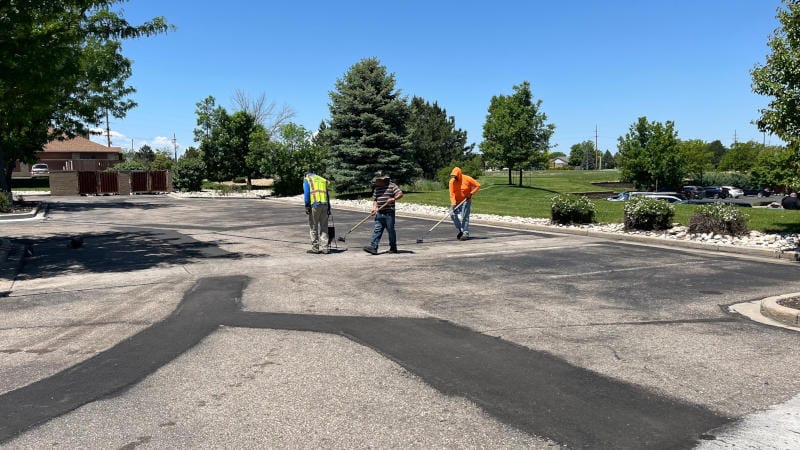
Signs Your Soil Is the Real Problem
Surface repairs on a soil-driven failure buy you a season or two at most. These indicators point to a subgrade issue rather than a surface issue.
- Cracks reappear in the same location within 12 to 24 months of repair
- Sections of pavement sit visibly higher or lower than adjacent areas
- Movement is seasonal, worse after spring melt and better in late summer
- Nearby sidewalks, curbs, or slabs show the same tilting or separation
- Water stands in the same spots after every storm despite the original grade
If two or more apply, an overlay is likely money spent twice. Our breakdown of when to replace versus repair explains where the line falls, and asphalt milling plus a rebuilt base is often the more economical long-term answer.
What This Means for Your Budget and Schedule
Soil remediation adds cost up front and removes cost later. Subexcavation, hauling, imported fill, and moisture conditioning can add meaningful line items to a bid, but they routinely double the service life of the finished pavement.
Schedule matters too. Moisture conditioning requires workable weather, so spring and early fall are ideal windows on the Front Range, and compacted subgrade should not be left exposed through a freeze.
If a bid comes in far below the others, check whether subgrade work was included at all. Our asphalt driveway cost breakdown and seasonal parking lot budget planning guide both show what a complete scope looks like.
Where Enright Asphalt Works
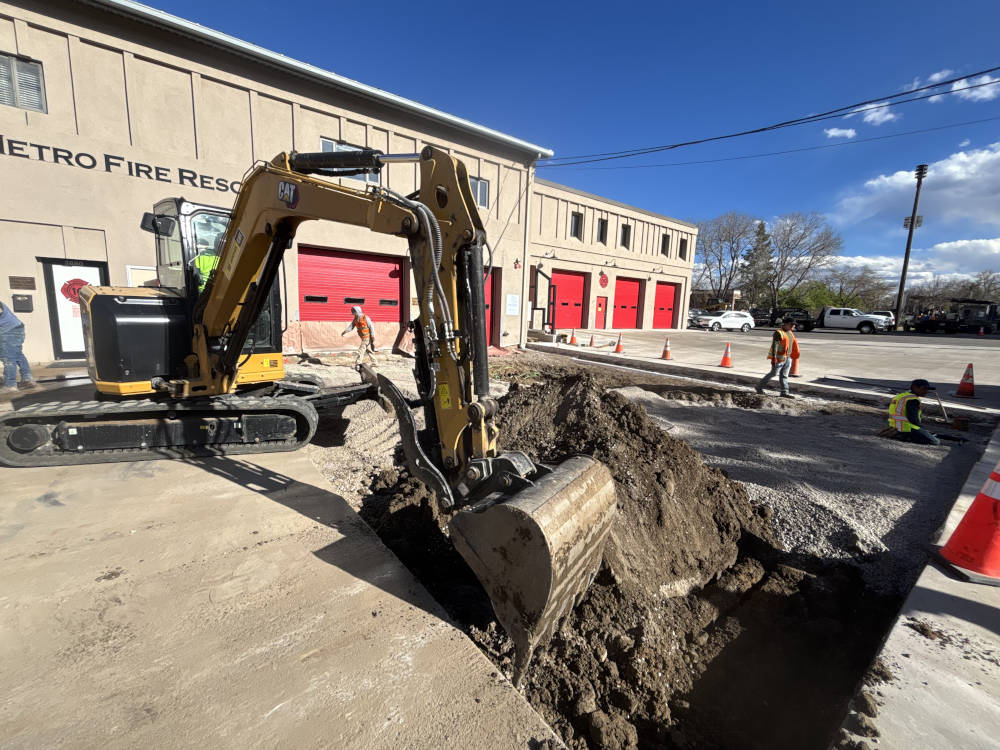
Enright Asphalt is based at 7279 E 96th Ave, Unit F, Henderson, CO 80640, and we serve the entire Denver metro area plus the surrounding Front Range communities. Our full service area includes:
Arvada, Aurora, Boulder, Brighton, Broomfield, Commerce City, Englewood, Erie, Evergreen, Fort Collins, Golden, Greeley, Henderson, Lafayette, Lakewood, Littleton, Longmont, Louisville, Loveland, Morrison, Niwot, Northglenn, Superior, Thornton, Westminster, and Wheat Ridge.
We handle parking lot paving, asphalt overlay and resurfacing, asphalt driveways, and concrete services across all of it. If your city is not listed, contact us and ask.
Frequently Asked Questions
What type of soil is under most of Denver?
Most of the Denver metro sits on expansive clay soil derived from the Pierre Shale and Denver Formation, rich in bentonite and montmorillonite. Pockets of sand, silt, and loam exist within city limits, but clay dominates and drives most pavement failures.
Can you pave directly on clay soil?
You can, but you should not. Paving over untreated expansive clay in Colorado typically produces cracking within one to three seasons. Subexcavation of 2 to 4 feet, moisture conditioning, and proper drainage are standard requirements for a reason.
Is Boulder soil rocky compared to Denver?
Generally yes. Boulder sits against the foothills where cobbly granitic alluvium such as the Nederland series is common, and that material can run 50 percent or more coarse fragments by volume. Swelling Pierre Shale clay still appears on the slopes, so Boulder projects often mix both conditions on one site.
Why do Loveland and Greeley need different pavement designs?
Loveland’s clay loam floodplain soils are somewhat poorly drained with a seasonal high water table, so drainage and pumping control dominate the design. Greeley sits on smectitic loess plus sandy soils to the south, so the challenge there is variability across a single site. See our Loveland and Greeley service pages for local scope.
Does soil testing add much to a paving project?
A geotechnical report is a small fraction of total project cost and routinely prevents a full rebuild later. On commercial work it is effectively mandatory, and most Front Range jurisdictions require one before approving a pavement section.
How long should asphalt last on Colorado clay soil?
With proper subgrade preparation and regular maintenance, expect 15 to 20 years from an asphalt parking lot and 20 or more from a residential driveway. Without subgrade work, that drops to roughly 5 to 8 years. Curing matters too, as covered in how long it takes asphalt to set.
Does winter de-icing make soil problems worse?
Indirectly, yes. Salts and de-icers open the pavement surface and joints, which lets more water reach the subgrade. Our guide on repairing salt-damaged concrete in Denver covers the surface side of that problem.
Get a Soil-Aware Paving Estimate
Every quote we write starts with the ground, not the surface. Call 720-637-4960 or request a free estimate and we will assess your subgrade conditions before recommending a scope. You can also browse our past work or read more about Enright Asphalt.