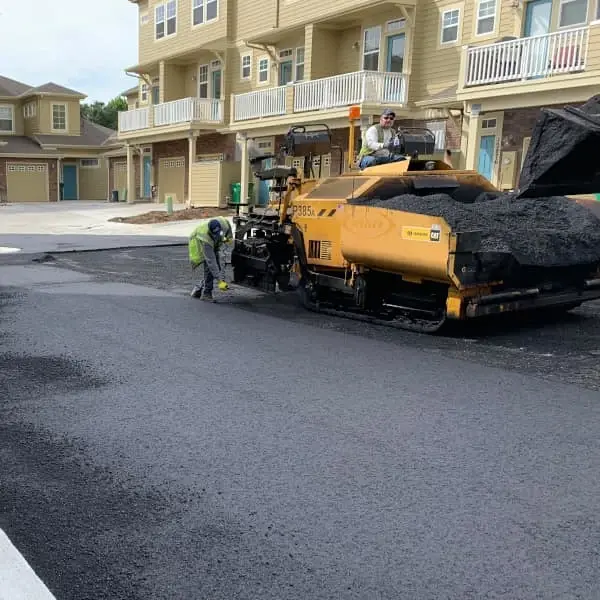

Your parking lot is the first thing customers, tenants, and vendors see when they arrive. A cracked or poorly drained lot signals neglect before anyone walks through the door. A clean, well-marked lot does the opposite.
Enright Asphalt has been paving commercial properties across the Denver metro for 30 years. We build parking lots for office complexes in Englewood, retail centers in Aurora, warehouse facilities in Commerce City, and HOA communities across the Front Range. From site grading and base prep through asphalt paving, concrete curbing, line striping, and ADA compliance, we handle the full project with one crew.
The Properties We Serve
We work with property managers, business owners, and facility directors throughout Denver, Aurora, Thornton, Westminster, Arvada, Lakewood, Englewood, Littleton, Parker, Centennial, Brighton, and Commerce City.
- Office parks and professional complexes
- Retail centers and shopping plazas
- Industrial warehouses and distribution facilities
- Medical offices and healthcare campuses
- Apartment complexes and HOA communities
- Churches, schools, and daycare facilities
- Restaurants and hospitality properties
- Municipal and government facilities
Different properties load their pavement differently. A restaurant lot with constant short-stay turnover wears faster than an office lot used nine to five. A delivery warehouse sees axle loads that a medical office never will. We account for those differences before recommending a thickness or base depth.
Our Parking Lot Paving Services
New Parking Lot Construction
We handle the complete scope: site clearing, excavation, subgrade preparation, grading for drainage, compacted Class 6 road base, asphalt paving, concrete curbing, line striping, ADA-compliant spaces and ramps, bollards, and speed bumps. One crew, one point of contact.
Base depth and asphalt thickness are set by your expected traffic load. Standard passenger car lots are built with 6 inches of compacted Class 6 road base and 3 inches of hot mix asphalt. Lots serving semi-trucks, delivery fleets, or heavy equipment need 8 inches of base and 5 to 8 inches of asphalt, depending on axle weights.
Asphalt Milling and Overlays
When the surface shows wear but the base is still sound, an overlay is the most cost-effective option. We mill off 1.5 to 2 inches of damaged asphalt, apply a tack coat to bond the layers, then install fresh hot mix asphalt. A properly executed overlay extends the parking lot’s service life by 10 to 15 years at a fraction of replacement cost.
An overlay works when you’re dealing with surface cracking, fading, or minor rutting. If you’re seeing alligator cracking across large areas, deep potholes, or persistent water pooling, the base is failing. Paving over a failing base just delays the same problem. If we find evidence of base failure during our site assessment, we’ll tell you directly.
Full-Depth Parking Lot Replacement
When a parking lot has widespread structural failure, patching and overlays are not a lasting fix. We remove the failed asphalt and base material entirely, address any underlying drainage problems, compact a new base, and pave with fresh asphalt calibrated to your traffic loads. A properly built replacement lot performs for 20 to 25 years with routine maintenance.
Striping, ADA, and Safety Features
A paved surface is not a parking lot until it is properly marked and equipped. We handle all finishing work in-house:
- Line striping: parking spaces, fire lanes, directional arrows, crosswalks, and loading zones using traffic-grade reflective paint
- ADA-compliant accessible spaces with correct dimensions and maximum 2% cross-slope
- ADA curb ramps and truncated dome detectable warning surfaces
- Concrete curbing and wheel stops
- Bollards to protect storefronts, loading docks, and building corners
- Speed bumps for high-pedestrian areas
How We Work
Parking lot work disrupts your business. What we can control is how much disruption we cause and how well we communicate around it. We schedule around your operation. If your lot needs to stay partially open, we phase the work so customers always have access. Office parks and retail centers often need evening or weekend work. We have done it for 30 years.
Enright Asphalt is a family-owned business. We carry full workers’ compensation coverage and are fully licensed and insured for commercial work throughout Colorado. Everything is handled in-house, so there is one point of accountability from site prep through final striping.
Keeping Your Parking Lot in Good Shape
The properties that get the most life out of their asphalt follow a simple schedule:
- Sealcoating every 2 to 3 years, starting 90 days after initial installation. Sealer blocks UV oxidation, keeps the surface flexible, and slows water infiltration.
- Crack sealing as soon as cracks appear. Cracks wider than a quarter-inch need to be filled before winter. Water in a crack freezes, expands, and widens it.
- Prompt pothole patching. A small pothole left through a Denver winter becomes a much larger one by spring.
- Re-striping when paint fades. Faded lines create confusion and signal to tenants that the property is not well managed.
Denver Parking Lot Paving: Common Questions
How thick should a parking lot be in Denver?
Standard passenger car lots: 3 inches of asphalt over 6 inches of compacted Class 6 road base. High-turnover lots like restaurants and retail: 4 to 5 inches. Lots serving delivery trucks or heavy equipment: 5 to 8 inches over 8 or more inches of base. Unstable subgrade soils in the Denver area sometimes require additional base depth or geotextile fabric before base installation.
How long will a parking lot last in Denver?
A properly built and maintained parking lot in Denver should last 20 to 25 years. Traffic volume is the biggest variable. A lightly used office lot with regular sealcoating can exceed that range. A busy drive-through that never gets maintained will need major work within 10 years. Sealcoating every 2 to 3 years and crack sealing promptly are the two things that have the biggest impact on lifespan.
How does Colorado’s climate affect parking lot asphalt?
The freeze-thaw cycle is the primary threat. Water gets into cracks, freezes overnight, expands, and widens the crack. Repeated over hundreds of cycles across Denver winters, this is what turns hairline cracks into alligator cracking and eventually structural failure. Denver’s elevation and 300-plus days of sunshine also accelerate UV oxidation, making asphalt brittle and prone to cracking under traffic loads. Sealcoating addresses both: it keeps water out and shields the surface from UV damage. Snowplow damage is also worth accounting for. A blade set too low scrapes and gouges the surface. If your property is plowed regularly, we add extra surface thickness to compensate.
What does ADA compliance require for a parking lot?
The ADA requires a minimum number of accessible spaces based on total lot size, with at least one van-accessible space per accessible cluster. Accessible spaces must be 8 feet wide with a 5-foot access aisle (8 feet for van-accessible spaces), and the surface slope cannot exceed 2% in any direction. They must connect to an accessible path to the building entrance via curb ramps with truncated dome detectable warning surfaces. We build to ADA standards on every commercial project and can bring existing non-compliant lots into compliance.
Get a Free Parking Lot Estimate
Whether you are building a new lot, deciding between an overlay and full replacement, or trying to extend the life of what you have, we will give you a straight answer and a fair price. Enright Asphalt has been doing this work in Denver for 30 years. Call us at 720-637-4960 or fill out the estimate form and we will come out, assess the property, and tell you exactly what we would recommend and what it will cost.