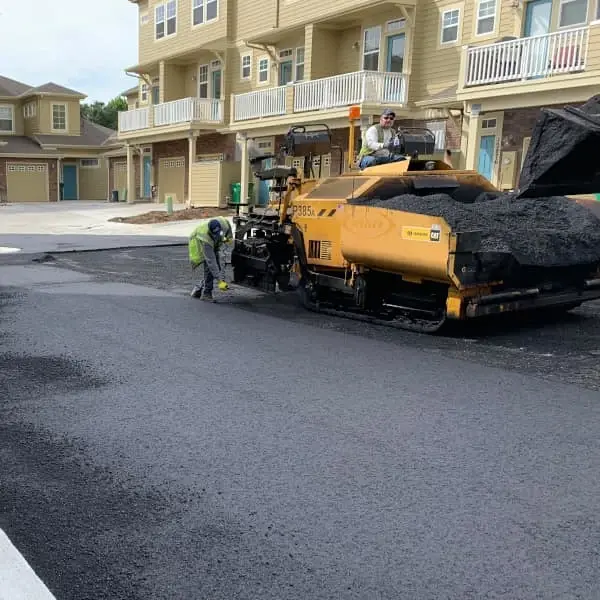

Enright Asphalt builds concrete parking lots and parking areas for commercial, industrial, and multi-family properties across Denver and the Front Range. A concrete parking surface lasts 30 to 40 years with minimal maintenance. It handles heavy vehicle loads without rutting or deforming. It resists oil, fuel, and hydraulic fluid that break down asphalt on contact. When your property needs a parking surface built for durability and the lowest total cost of ownership, concrete is the material that delivers.
We’ve been pouring commercial concrete in the Denver metro for over 30 years. We hold an A+ BBB rating and our crews build concrete parking surfaces engineered for Colorado’s freeze-thaw cycling, UV intensity, and clay soils. You get a parking area designed for this market, not a generic spec from a crew unfamiliar with what altitude and temperature extremes do to concrete.
The Real Cost Is What You Spend Over 30 Years
Concrete costs more to install than asphalt. Most property managers see that number first, and it’s a real consideration. But the total cost of ownership tells a different story. A concrete parking lot lasts 30 to 40 years. Asphalt typically lasts 15 to 20. In that same 30-year window, an asphalt lot needs sealcoating every 3 to 5 years, crack sealing every 1 to 2 years, patching as potholes develop, and often a full overlay or replacement around year 15. Concrete needs joint sealing every few years and occasional cleaning. That’s about it.
When you compare the installed cost plus 30 years of maintenance, concrete frequently comes out ahead. For properties where pavement longevity matters, where heavy vehicles are part of daily operations, or where you simply don’t want to deal with recurring maintenance, concrete is the smarter investment.
Less Maintenance, Fewer Disruptions, Better Lot
For property managers, concrete parking means fewer service calls, fewer vendor appointments, and fewer tenant or customer disruptions. You’re not closing sections of your lot every 3 years for sealcoating. You’re not patching potholes every spring. You’re not planning a major resurface at year 15 that takes your lot offline for a week.
Concrete also looks cleaner for longer. It doesn’t fade to gray the way asphalt does. Oil stains are easier to clean from concrete than from asphalt, where they dissolve the binder and leave permanent dark spots. A concrete lot maintains a professional appearance with minimal effort, which matters for retail, medical, and multi-tenant properties where first impressions affect business.
Our Concrete Parking Lot Services in Denver, CO
We provide complete concrete parking area construction, including:
- Full concrete parking lot installation for retail, office, medical, multi-family, and industrial properties
- Loading dock aprons and service area slabs designed for sustained heavy loads
- Dumpster pad construction with reinforced concrete and approach aprons
- Drive-through lane and drive aisle construction
- Concrete curb and gutter installation
- ADA-compliant accessible parking spaces, curb ramps, and accessible routes
- Combination projects with concrete in high-stress zones and asphalt in standard parking areas
- Replacement of failed asphalt sections with concrete in problem areas
- Control joint layout and sealing for long-term crack management
- Penetrating sealer application after curing for moisture and stain protection
Whether you need a full concrete parking lot for a new development or targeted concrete replacement in areas where asphalt keeps failing, we scope the work to your property’s actual needs.
Where Concrete Outperforms Asphalt
Both materials work for general parking. But concrete is the clear winner in specific high-stress applications that destroy asphalt prematurely. Here’s where the difference matters most:
Loading Docks and Service Areas
Delivery trucks with loaded axle weights exceeding 20,000 pounds sit at loading docks for extended periods while freight is unloaded. That concentrated, sustained weight pushes asphalt downward, creating permanent ruts and depressions. The problem gets worse in summer when Denver’s heat softens the asphalt binder. Concrete’s rigid structure distributes these loads across the slab without deforming. If your facility receives regular truck deliveries, the loading dock apron should be concrete.
Dumpster Pads
Front-loading garbage trucks weigh up to 60,000 pounds when fully loaded. The truck pulls up to the same exact spot every pickup day, drops steel forks into the container, and lifts several tons overhead. That concentrated, repetitive load destroys asphalt pads within 2 to 4 years. Hydraulic fluid leaking from the truck’s lift mechanism dissolves asphalt binder on contact, accelerating the failure. A 6 to 8 inch reinforced concrete pad in the dumpster area lasts 20 to 30 years and resists the fluid exposure.
Drive-Through Lanes
Vehicles idling in drive-through lines apply sustained point loads in the same spots day after day. Tires sitting in one position for minutes at a time create depressions in asphalt, especially during summer heat. Over time, these ruts create a rough, uneven surface that gives customers a poor experience. Concrete doesn’t rut or deform under idling vehicles. The surface stays smooth and level regardless of how long vehicles sit in one spot.
Fuel and Chemical Exposure Areas
Oil, transmission fluid, gasoline, diesel, and hydraulic fluid all attack asphalt binder on contact. The petroleum in these fluids dissolves the petroleum-based binder that holds asphalt aggregate together. Over time, fluid drips create soft spots that turn into potholes. Concrete doesn’t use a petroleum-based binder. It resists these chemicals without breaking down. Properties with fleet vehicles, fueling areas, maintenance bays, or heavy equipment storage benefit from concrete surfaces in areas where fluid drips are inevitable.
Heavy Truck Turning Areas
When trucks turn sharply at low speeds, the tires apply intense shearing forces to the pavement surface. Asphalt scuffs, tears, and pushes laterally under these forces, creating ridges and rough spots at every turning point. You’ll see this at intersections, turnaround areas, and tight maneuvering zones in any truck-heavy facility. Concrete absorbs shearing forces without displacement. The surface stays flat and intact regardless of how many turning movements it handles.
Concrete vs. Asphalt Parking: A Quick Comparison
Here’s how the two materials stack up across the factors that matter most to property managers:
| Factor | Concrete | Asphalt |
| Typical lifespan | 30 to 40 years | 15 to 20 years |
| Upfront installation cost | Higher | Lower |
| Lifetime maintenance cost | Lower (joint sealing, occasional cleaning) | Higher (sealcoat every 3 to 5 years, crack repair, patching, overlay at year 15) |
| Heavy load performance | Rigid, no rutting under sustained or static loads | Softens and ruts under sustained loads, especially in heat |
| Chemical resistance | High, resists oil, fuel, and hydraulic fluid | Low, petroleum-based fluids dissolve asphalt binder |
| Installation time | Longer (7 to 28 day curing period) | Shorter (drivable within 1 to 3 days) |
| Repair approach | Panel replacement (more complex per repair) | Patching, overlay, and crack sealing (simpler per repair) |
| Sealcoating required | No | Yes, every 3 to 5 years |
| Best applications | Loading docks, dumpster pads, drive-throughs, heavy truck areas, long-term investment | Standard parking stalls, budget-sensitive projects, temporary lots |
Not sure which material fits your property? We install both and can recommend the right approach based on your traffic patterns, load requirements, and budget. Many of our projects use a strategic combination: concrete where heavy loads and chemical exposure concentrate, asphalt where standard parking keeps the overall cost down.
Typical Concrete Parking Sections
Concrete thickness and reinforcement depend on the loads your parking area handles. The American Concrete Institute’s ACI 330R guide provides the design framework. Here are the sections we commonly install in Denver:
| Application | Concrete Thickness | Reinforcement | Sub-Base |
| Passenger car parking | 4 to 5 inches | Wire mesh or #4 rebar at 18-inch centers | 4 to 6 inches compacted aggregate |
| Light truck and delivery | 5 to 6 inches | #4 rebar at 12 to 18-inch centers | 6 inches compacted aggregate |
| Heavy truck / loading dock | 6 to 8 inches | #4 or #5 rebar at 12-inch centers both directions | 6 to 8 inches compacted aggregate |
| Dumpster pads | 6 to 8 inches | #4 rebar at 12-inch centers both directions | 6 inches compacted aggregate |
| Drive-through lanes | 5 to 6 inches | #4 rebar at 18-inch centers | 6 inches compacted aggregate |
These are starting points. We design each parking area based on your property’s geotechnical report, anticipated traffic loads, and applicable engineering specifications. If you have an engineer’s pavement design, we bid and build to that spec. If you need us to recommend a section, we do that based on site conditions and intended use.
How We Build Concrete Parking Areas
A concrete parking lot that lasts 30+ years in Colorado starts below the surface. The sub-base, the mix, the reinforcement, the curing, and the joints all have to be right. Here’s our process:
- Site evaluation and design. We review the property layout, traffic patterns, load requirements, drainage, and ADA compliance needs. We determine slab thickness, reinforcement type and spacing, joint layout, and sub-base specifications. If the project involves replacing existing asphalt, we plan demolition and hauling as part of the scope.
- Demolition and removal (for replacement projects). We saw-cut the perimeter, break out the old asphalt or concrete, and haul all debris off-site for recycling. We protect adjacent surfaces, landscaping, and utilities throughout the process.
- Sub-base preparation. This is the step that determines whether your lot lasts a decade or three. We grade the exposed subgrade, remove any soft or clay-heavy material, and install 4 to 8 inches of crushed aggregate base depending on soil conditions. We compact the base with vibratory equipment and verify density. In Denver’s clay-heavy soils, thorough sub-base work prevents the settling and heaving that crack concrete from below.
- Forming and reinforcement. We set forms to define slab edges, drive aisles, curb lines, and any grade transitions. We lay rebar or wire mesh reinforcement on support chairs at the specified spacing. Control joint locations are planned before the pour so the concrete cracks where we want it to, not randomly across the surface.
- Concrete pour. We use air-entrained concrete rated at 3,500 to 4,500 PSI for commercial parking applications. Air entrainment introduces microscopic bubbles that give freezing water room to expand inside the slab. This is non-negotiable in Denver’s freeze-thaw climate, where the Front Range sees 50 or more cycles per winter. The crew places, screeds, and finishes the concrete in planned sections.
- Joint cutting. We saw-cut control joints within 12 to 24 hours of the pour while the concrete is still green. Joint spacing follows the ACI guideline of approximately 2 to 3 times the slab thickness in feet. For a 6-inch slab, that means joints every 12 to 18 feet. Properly spaced joints control where shrinkage cracking occurs and keep the surface clean and uniform.
- Curing. Concrete reaches about 70% of its design strength at 7 days and full strength at 28 days. We apply curing compound immediately after finishing to retain moisture in the slab. Denver’s dry, high-altitude air pulls moisture from the surface faster than humid climates. If the surface dries too quickly, it weakens and develops premature cracking. Curing management is one of the most important steps in Colorado concrete work.
- Joint sealing. After the concrete has fully cured, we seal all contraction joints and construction joints with a flexible sealant. Sealed joints prevent water from penetrating below the slab, where it would erode the sub-base and accelerate freeze-thaw damage from underneath. In Denver’s climate, sealed joints are the primary defense against base erosion.
- Striping and markings. We apply parking stall lines, ADA accessible space markings, fire lane markings, directional arrows, crosswalks, and any other required pavement markings per the approved site plan. Striping goes down after the surface is fully cured and ready to accept paint.
Most commercial concrete parking projects take 1 to 3 weeks depending on size and phasing requirements. We can phase the work to keep portions of your lot open during construction so your tenants and customers maintain access throughout the project.
Building Concrete for Denver’s Climate
Colorado’s conditions create specific challenges for concrete parking surfaces. Here’s what we account for on every project:
- Freeze-thaw cycling. The Front Range sees 50+ cycles per winter. Water trapped in non-air-entrained concrete expands by roughly 9% each time it freezes, generating enough internal pressure to crack slabs from within. Air-entrained mix is mandatory for any exterior concrete in Denver.
- Clay soils. Much of the Denver metro sits on expansive clay that swells when wet and shrinks when dry. Without adequate sub-base depth and compaction, clay movement beneath the slab causes uneven settling and structural cracking. We follow geotechnical recommendations for base depth and add material when conditions warrant it.
- UV intensity at altitude. UV radiation at 5,280 feet is measurably stronger than at sea level. While UV affects asphalt more severely than concrete, unprotected concrete surfaces still benefit from sealing to prevent moisture absorption, staining, and surface degradation.
- Dry air and rapid moisture loss. Denver’s low humidity pulls water from fresh concrete faster than humid climates. If the surface dries before the interior has cured, it creates a weak top layer prone to spalling and scaling. Proper curing compound application immediately after finishing is essential.
- Temperature swings. Daily temperature changes of 40 to 50 degrees are common, especially in spring and fall. This thermal stress puts expansion and contraction pressure on the slab, making proper joint spacing and flexible joint sealant critical for crack control.
What Affects Your Concrete Parking Project
Every property is different. Here are the main factors that influence scope:
- Total square footage of the parking area
- Slab thickness and reinforcement design based on load requirements
- Whether the project is new construction or replacement of existing pavement
- Sub-base condition and whether soil remediation or extra base depth is needed
- Drainage and stormwater management requirements
- ADA compliance work (accessible spaces, ramps, accessible routes)
- Curb and gutter scope
- Phasing requirements to maintain partial lot access during construction
- Striping, ADA markings, fire lane markings, and signage needs
- Time of year and weather conditions during installation
Every project is different. Call Enright Asphalt at 720-637-4960 for a free estimate so you know exactly what you’re getting into before any work starts.
Frequently Asked Questions
How long does a concrete parking lot last?
A properly built concrete parking lot lasts 30 to 40 years with minimal maintenance. The primary upkeep is periodic joint sealing and keeping the surface clean. Compare that to asphalt, which typically lasts 15 to 20 years and needs sealcoating every 3 to 5 years plus regular crack repair and patching. Over a 30-year horizon, concrete’s lower maintenance requirements often offset the higher upfront cost.
Is concrete or asphalt better for a parking lot in Denver?
It depends on the application. Asphalt is more flexible and handles minor freeze-thaw movement well. It costs less upfront and installs faster. Concrete is more rigid, handles heavy loads without deforming, resists chemicals, and lasts roughly twice as long. For standard passenger parking, either material works well. For loading docks, dumpster areas, drive-through lanes, and heavy truck zones, concrete is the stronger choice. Many Denver properties use both materials strategically.
How thick does a commercial concrete parking lot need to be?
Four to 5 inches of concrete on a compacted aggregate base handles passenger car traffic. Heavy truck areas, loading docks, and dumpster pads typically need 6 to 8 inches with #4 or #5 rebar at 12-inch centers in both directions. The right thickness depends on your expected loads and soil conditions. We follow the ACI 330R design guide and size every project to match its actual use.
Can you replace just part of an asphalt lot with concrete?
Yes. This is one of our most common concrete parking projects. If your loading dock apron, dumpster pad, or drive-through lane keeps failing in asphalt, we remove the asphalt in that section and pour a reinforced concrete slab designed for the load. The rest of your lot stays asphalt. This targeted approach gives you concrete’s durability where you need it most without converting the entire lot.
How long before a new concrete parking lot can handle traffic?
Light vehicle traffic can typically use the surface after 7 days. Full design strength is reached at 28 days. Heavy truck traffic and loading dock operations should wait the full 28 days before using the surface. We coordinate phasing and schedule around your operations so your property stays accessible during construction and curing.
Does a concrete parking lot need sealcoating?
No. Unlike asphalt, concrete does not require sealcoating. The main maintenance item is sealing the contraction joints every few years to prevent water from penetrating below the slab. We recommend applying a penetrating sealer to the surface after curing to protect against moisture absorption and staining, but it’s a one-time or infrequent application rather than the recurring 3 to 5 year cycle that asphalt demands.
Get a Free Concrete Parking Lot Estimate in Denver
If your parking area handles heavy loads, chemical exposure, or constant truck traffic, concrete is the surface that holds up without constant repairs. It costs more to install, but it costs far less to own over 30 years. That’s the number that matters.
Call Enright Asphalt at 720-637-4960 or fill out our estimate form to schedule a free assessment. We’ve been building concrete and asphalt parking surfaces in the Denver metro for over three decades. We’ll evaluate your property, discuss your options, and give you a clear estimate before any work begins.