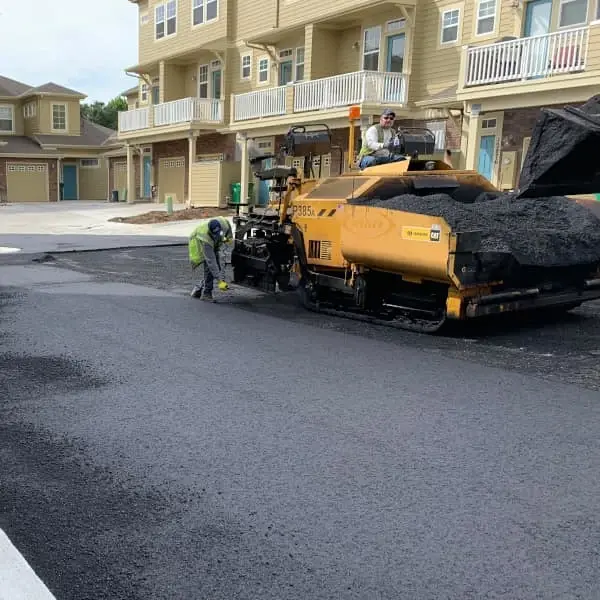

Enright Asphalt seals cracks in parking lots, access roads, and commercial pavement across Denver and the Front Range. Crack sealing is the single most cost-effective maintenance step you can take to extend your pavement’s life. It stops water from penetrating the surface and reaching the base layer, where moisture causes the majority of structural pavement failures. Sealed cracks last up to 8 years before retreatment is needed.
We’ve been maintaining and protecting Denver parking lots for over 30 years. We hold an A+ BBB rating and our crews understand how Denver’s freeze-thaw cycles, UV intensity, and temperature swings affect crack behavior differently than in other markets. You get crack sealing applied at the right time, with the right material, by a team that knows this climate inside out.
The Cheapest Repair Is the One You Don’t Need
An unsealed crack is an open door for water. In Denver, that water freezes and expands by roughly 9% every time the temperature drops below 32 degrees. The Front Range sees 50 or more freeze-thaw cycles per winter. Each cycle widens the crack, weakens the base material underneath, and pushes your parking lot closer to expensive structural repairs.
Industry research from Auburn University’s National Center for Asphalt Technology found that crack sealing on pavement in good condition can extend service life by more than 7 years. That’s years of avoided patching, pothole repair, and resurfacing. For property managers tracking maintenance budgets year over year, crack sealing delivers one of the highest returns of any pavement maintenance investment.
Protect Your Lot, Protect Your Liability
A parking lot full of widening cracks creates trip hazards for pedestrians, damages customer vehicles, and signals neglect to tenants and visitors. Sealed pavement looks maintained, drains properly, and reduces the slip-and-fall risks that lead to liability claims. For multi-tenant commercial properties, a well-maintained lot is a competitive advantage that keeps tenants renewing leases.
Crack sealing also preserves the pavement structure that supports everything else you’ve invested in: striping, signage, ADA markings, and drainage. When the asphalt underneath fails, all of those improvements need to be redone. Sealing cracks while the pavement is still in good condition keeps those investments intact.
Our Crack Sealing Services in Denver, CO
We provide comprehensive crack sealing for commercial and multi-family properties, including:
- Hot-pour rubberized crack sealing for working cracks (cracks that expand and contract with temperature)
- Crack filling for non-working cracks and minor surface fractures
- Routing of cracks to create a uniform reservoir that holds more sealant and extends treatment life
- Cleaning and preparation of all cracks using compressed air and heat lances before application
- Overband and flush-fill application methods based on crack width and location
- Parking lot-wide crack treatment programs with prioritized scheduling
- Integration with sealcoating programs for maximum pavement protection
- Annual or biannual maintenance contracts for ongoing crack management
Whether you have a few isolated cracks that need attention or a full lot that’s overdue for treatment, we scope the work to your property and your maintenance budget.
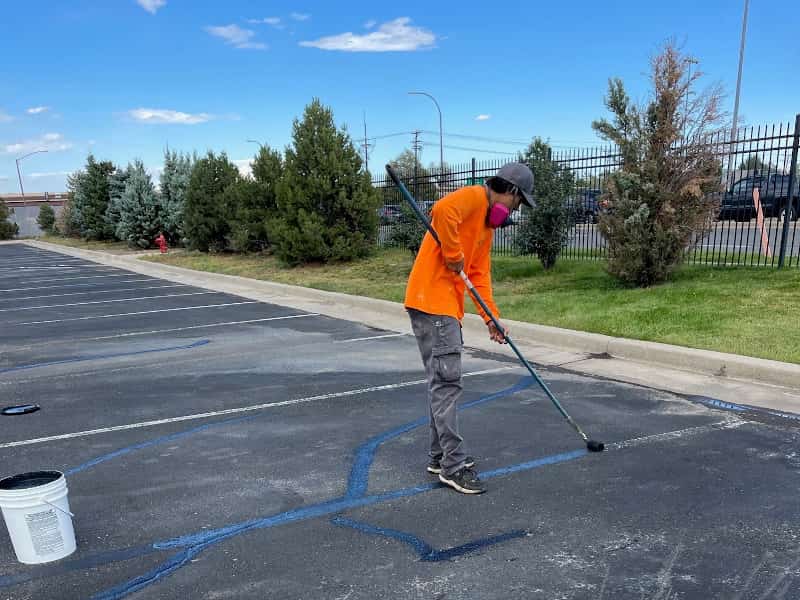
Crack Sealing vs. Crack Filling: What’s the Difference
These terms get used interchangeably, but they’re different treatments with different lifespans and applications. Understanding the difference helps you get the right repair for your situation.
Crack Sealing
Crack sealing uses a hot-applied, rubberized sealant that stays flexible after it cures. That flexibility is critical in Denver because our temperature swings of 40 to 50 degrees in a single day cause cracks to expand and contract constantly. A rigid filler would crack and separate within months. Rubberized sealant moves with the pavement and maintains its watertight seal through those cycles. Crack sealing typically lasts 5 to 8 years and is considered a long-term treatment.
Crack Filling
Crack filling uses asphalt-based emulsions or cutbacks that bond to the crack edges but don’t flex significantly. It works for non-working cracks, which are cracks that don’t move with temperature changes. Crack filling costs less upfront but lasts only 1 to 2 seasons in Denver’s climate because most cracks here are working cracks driven by freeze-thaw cycling. Filling is best suited as a short-term solution or for very minor surface fractures.
Crack Sealing vs. Crack Filling at a Glance
| Factor | Crack Sealing | Crack Filling |
| Material | Hot-applied rubberized sealant | Asphalt emulsion or cutback |
| Flexibility | High, moves with pavement | Low, rigid after curing |
| Best for | Working cracks (expand and contract) | Non-working cracks (minimal movement) |
| Lifespan | 5 to 8 years | 1 to 2 seasons |
| Preparation | Cracks routed, cleaned, and dried | Cracks cleaned, minimal prep |
| Cost | Higher per linear foot | Lower per linear foot |
| Best climate | Cold climates with freeze-thaw cycling | Mild climates with little temperature swing |
| Recommended for Denver | Yes, primary method | Limited, for minor surface cracks only |
In Denver’s climate, crack sealing is the recommended method for the vast majority of parking lot cracks. The temperature extremes here make nearly every crack a working crack. We use crack filling only for minor, stable surface fractures where flexibility isn’t needed.
Types of Cracks We Treat
Not every crack means the same thing. Understanding what’s causing the cracking helps us apply the right treatment and advise you on what to expect.
Longitudinal Cracks
These run parallel to the direction of traffic or along the centerline of the pavement. They often form at paving joints or along the edges of lanes. Longitudinal cracks respond well to hot-pour sealing because they tend to be clean-edged and consistent in width.
Transverse Cracks
These run perpendicular to the traffic direction and are typically caused by thermal contraction in cold weather. Denver’s extreme temperature swings make transverse cracking common. These are classic working cracks that expand in winter and contract in summer. Rubberized sealant is the right treatment.
Block Cracking
Block cracks form in large rectangular patterns, usually caused by aging and oxidation of the asphalt binder. At Denver’s altitude, UV radiation accelerates this oxidation. Block cracking across an entire lot often signals that the pavement is approaching end of life, but sealing the cracks buys time by keeping water out until you’re ready for resurfacing or replacement.
Edge Cracking
Cracks along the outer edges of the pavement, often caused by poor drainage or inadequate base support at the perimeter. Edge cracks let water undermine the pavement from the outside in. Sealing them early prevents the damage from working inward toward higher-traffic areas.
Reflective Cracking
These appear in overlaid pavement, reflecting the crack pattern from the layer underneath up through the new surface. Reflective cracks are common on parking lots that were overlaid without milling first. Sealing them slows their progression and prevents water infiltration, but they’ll continue to reflect unless the underlying cause is addressed.
How We Seal Parking Lot Cracks
Proper crack sealing is more than running sealant over a crack. Preparation determines how long the seal lasts. Here’s our process:
- Inspect the entire parking lot. We identify and map all cracks, noting their type, width, depth, and activity level. We also flag areas where cracking has progressed beyond sealing into structural territory, like alligator cracking or base failures, so you know what sealing can fix and what it can’t.
- Route the cracks (when specified). For cracks wider than a quarter inch, we use a crack router to create a uniform reservoir, typically 3/4 inch wide by 3/4 inch deep. This reservoir holds more sealant and creates a consistent contact area along both edges of the crack. Routing significantly extends treatment life.
- Clean each crack thoroughly. We use compressed air to blow out dirt, sand, vegetation, and loose debris. For cracks with moisture, we use heat lances to dry the interior. Sealant won’t bond to dirty or wet crack walls. This step is non-negotiable.
- Apply hot-pour rubberized sealant. The sealant is heated to manufacturer-specified temperatures, typically 375 to 400 degrees Fahrenheit, and applied using a pour pot or wand. We use either overband application (sealant extends slightly over both edges of the crack for maximum coverage) or flush-fill (sealant is level with the pavement surface) depending on location and traffic patterns.
- Allow proper cure time. The sealant needs to cool and set before traffic resumes. Most hot-pour materials are traffic-ready within 15 to 30 minutes in warm conditions. We manage traffic flow so vehicles don’t track through uncured sealant.
- Document and recommend follow-up. We note any areas that need additional maintenance, patching, or eventual resurfacing. For properties on a maintenance contract, we schedule the next inspection based on the crack activity and local conditions.
Crack sealing is best done in spring or fall when ambient temperatures are between 40 and 70 degrees Fahrenheit. At these temperatures, cracks are partially open, allowing sealant to penetrate and fill the reservoir. Sealing in summer when cracks are compressed shut reduces sealant penetration and shortens treatment life.
What Affects Your Crack Sealing Project
These are the main variables that influence scope:
- Total linear footage of cracks to be sealed
- Average crack width and whether routing is required
- Type of cracks (working vs. non-working, linear vs. branching)
- Overall pavement condition (crack sealing works best on pavement still in good condition)
- Whether integration with sealcoating is planned
- Site access and traffic management requirements
- Time of year and ambient temperature
- Maintenance contract vs. one-time treatment
Every property is different. Call Enright Asphalt at 720-637-4960 for a free estimate so you know exactly what you’re getting into before any work starts.
Frequently Asked Questions
How often should a parking lot have cracks sealed?
Inspect annually and seal new cracks as they appear. Hot-pour rubberized sealant typically lasts 5 to 8 years per application. In Denver’s climate, we recommend annual inspections in spring to catch any cracks that opened over the winter. Properties on a maintenance contract get these inspections built into their schedule.
Should I seal cracks before or after sealcoating?
Before. Cracks should be sealed first, then sealcoating applied over the entire surface. Sealcoating over unsealed cracks doesn’t prevent water from getting through. The crack seal creates the watertight barrier, and the sealcoat protects the rest of the surface. Doing both in the same season is the most efficient approach.
Can you seal cracks in winter?
Hot-pour crack sealing works best between 40 and 70 degrees Fahrenheit. In Denver, that typically means spring and fall are ideal. Winter applications are possible on warmer days, but adhesion is reduced in very cold temperatures. We’ll advise you on timing based on your urgency and the weather forecast.
Is crack sealing worth it on an older parking lot?
It depends on the overall condition. If the pavement is structurally sound with surface cracks but no base failure, sealing extends the lot’s life and delays the need for resurfacing or replacement. If alligator cracking, potholes, and settling are widespread, sealing won’t address the underlying structural problems. We’ll give you an honest assessment of whether sealing is the right investment for your lot’s current condition.
Do you offer maintenance contracts for crack sealing?
Yes. Many of our commercial clients prefer annual or biannual maintenance contracts that include crack sealing, sealcoating, and minor asphalt repairs on a set schedule. A maintenance program catches problems early and costs less over time than waiting for damage to escalate. We’ll build a program around your property’s specific needs and budget.
How long does crack sealing take on a typical parking lot?
Most small to mid-size parking lots can be completed in 1 day. Larger commercial properties may take 2 to 3 days depending on the total linear footage and whether routing is required. The sealed cracks are ready for traffic within 15 to 30 minutes of application, so downtime is minimal.
Get a Free Crack Sealing Estimate in Denver
Every crack you leave open is an invitation for water damage. In Denver, that water freezes dozens of times every winter, turning hairline cracks into potholes and potholes into structural failures. Sealing cracks while the pavement is still in good shape is the most cost-effective decision you can make.
Call Enright Asphalt at 720-637-4960 or fill out our estimate form to schedule a free parking lot assessment. We’ve been protecting Denver pavement for over 30 years. We’ll inspect your lot, identify what needs treatment, and give you a clear estimate before any work begins.