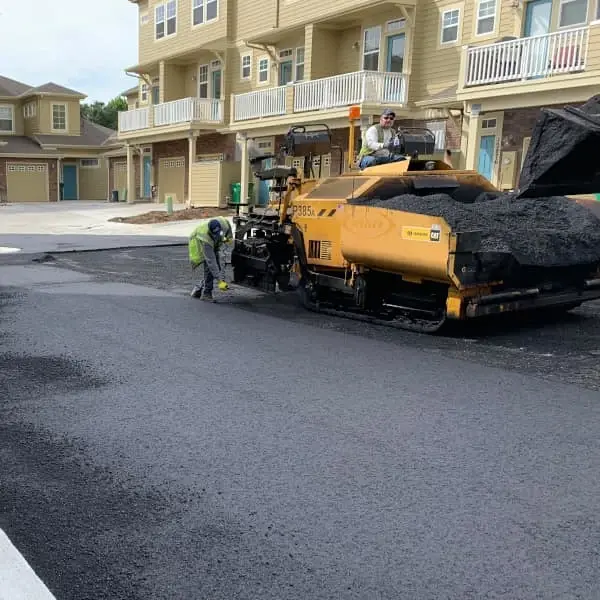

Enright Asphalt removes and replaces worn-out concrete driveways for homeowners across Denver and the Front Range. When cracks cover more surface than solid concrete, when slabs have sunk or heaved beyond leveling, or when repairs keep failing season after season, replacement is the smarter investment. We handle the full job, from demolition to a finished, sealed driveway built for Colorado’s climate.
We’ve been pouring and protecting concrete in the Denver metro for over 30 years. We hold an A+ BBB rating, and our crews understand the specific soil conditions, elevation factors, and freeze-thaw pressures that determine whether a driveway lasts 10 years or 30. You get a driveway engineered for this market, not a generic pour from an out-of-state crew. See all of our residential services to learn how we help homeowners across the Front Range.
When Replacement Saves You More Than Repairs
A well-built concrete driveway lasts 25 to 30 years on average. In Denver’s high-altitude climate, freeze-thaw cycling and intense UV exposure can shorten that timeline if the original pour wasn’t built to spec. Once a driveway reaches the point where concrete driveway repairs are needed every year or two, replacement becomes the more cost-effective path.
Patching a driveway that’s structurally compromised is like putting a bandage on a broken bone. The surface might look better for a few months, but the underlying damage keeps spreading. A full replacement gives you a new sub-base, proper drainage, fresh concrete mixed for Colorado conditions, and a sealed surface that resets the clock on deterioration. That’s decades of protection versus a few seasons of temporary fixes.
A New Driveway Changes How Your Whole Property Looks
Your driveway is one of the largest visible surfaces on your property. A crumbling, uneven slab drags down the appearance of the entire home, no matter how well the rest of the landscaping looks. A new concrete driveway delivers an immediate visual upgrade that neighbors and potential buyers notice right away.
Beyond curb appeal, a replacement eliminates the safety hazards that come with sunken sections, wide cracks, and uneven joints. Trip-and-fall risks disappear. Water stops pooling in low spots. You get a clean, level surface that looks right and works right for years to come.
Our Concrete Driveway Replacement Services in Denver, CO
We handle every phase of driveway replacement in-house, including:
- Complete demolition and removal of existing concrete
- Sub-base evaluation, grading, and compaction
- Drainage assessment and correction
- New concrete pour with air-entrained, 4,000+ PSI mix designed for Colorado freeze-thaw conditions
- Steel reinforcement (rebar or fiber mesh) based on load requirements
- Control joint placement for managed cracking
- Decorative finish options: broom finish, stamped, colored, or exposed aggregate
- Post-cure sealing with penetrating sealer rated for high-altitude UV and moisture
Whether you’re replacing a two-car driveway or a longer approach with turnaround space, we size the job to your property and build it to handle your daily use.
Signs Your Concrete Driveway Needs Replacement
Not every damaged driveway needs a full tear-out. But when you see multiple signs from this list, replacement is almost always the better call:
Widespread Cracking
Hairline cracks are normal. But when cracks wider than a quarter inch cover large sections, water is getting deep into the slab with every rain and snowmelt. In Denver, that moisture freezes and expands by about 9% according to the Portland Cement Association. Each freeze-thaw cycle widens the cracks further. Once cracking is this extensive, filling individual cracks won’t stop the cycle.
Sinking, Heaving, or Uneven Slabs
Denver-area soils are heavy in clay. Clay swells when wet and shrinks when dry, creating voids under your slab that cause settling and heaving. If sections of your driveway have shifted more than an inch or two, the sub-base has likely failed. Leveling can help in mild cases, but significant movement means the foundation underneath needs to be rebuilt, and that requires replacement.
Severe Spalling and Surface Deterioration
Spalling is when the top layer of concrete flakes, pits, and peels away. De-icing chemicals like magnesium chloride, commonly tracked in from Colorado roads, accelerate this damage. When spalling covers more than 25 to 30 percent of the surface, resurfacing alone won’t hold. The slab integrity is compromised, and new concrete is the lasting fix.
Age Over 25 Years
If your driveway is approaching or past the 25-year mark and showing multiple symptoms, the math favors replacement. Industry data shows concrete driveways typically last 25 to 30 years under normal conditions. At Denver’s elevation with our intense UV exposure and temperature swings of 40 to 50 degrees in a single day, older driveways deteriorate faster than the national average.
Repeated Repair Failures
When patches keep cracking, filled joints keep separating, and leveled sections keep sinking, the problem is below the surface. The sub-base or soil conditions are no longer supporting the slab. More repairs won’t change that. A replacement addresses the root cause and gives you a stable foundation to build on.
Repair vs. Replacement: A Quick Comparison
| Factor | Repair | Replacement |
|---|---|---|
| Best for | Isolated cracks, minor spalling, small settled areas | Widespread damage, failed sub-base, age over 25 years |
| Lifespan of fix | 3 to 10 years depending on damage severity | 25 to 30+ years with proper maintenance |
| Sub-base | Existing base stays in place | Full sub-base rebuild with proper grading and compaction |
| Drainage | Existing drainage unchanged | Corrected during grading for proper water flow |
| Appearance | Patched areas visible | Uniform, clean surface across entire driveway |
| Long-term value | Lower upfront cost, but recurring expense | Higher upfront cost, decades of protection |
Not sure which route makes sense for your driveway? We’ll assess the damage, check the sub-base, and give you an honest recommendation during your free estimate.
Concrete Driveway Finish Options
A replacement is your chance to upgrade the look of your driveway, not just restore it. We offer several finish styles:
Broom Finish
The standard for residential driveways. A broom finish creates a lightly textured surface with excellent slip resistance, even when wet. It’s clean, durable, and cost-effective. Most Denver driveways use this finish.
Stamped Concrete
Stamped patterns mimic the look of brick, stone, slate, or tile. This is a popular upgrade for homeowners who want a decorative surface without the maintenance of individual pavers. Stamped concrete does require resealing every 2 to 3 years to maintain the color and pattern.
Colored Concrete
Integral color is mixed directly into the concrete, so the color goes all the way through the slab. This means scratches and minor wear don’t reveal a different color underneath. Earth tones and warm grays are popular choices in the Denver market.
Exposed Aggregate
The top cement layer is washed away to reveal the natural stone and gravel embedded in the mix. Exposed aggregate provides a textured, slip-resistant surface with a natural, high-end look. It’s a strong choice for Colorado homes where the aesthetic matches the landscape.
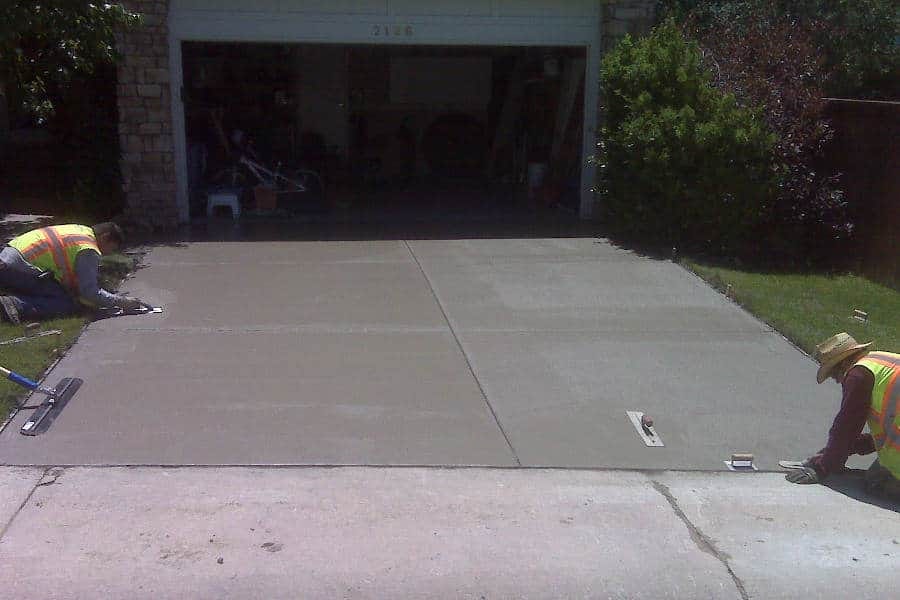
How We Replace a Concrete Driveway
Replacing a driveway is a multi-day process. Cutting corners on any step shows up as early failure down the road. Here’s how we do it right:
- Site evaluation and project planning. We inspect your existing driveway, check drainage patterns, evaluate soil conditions, and discuss finish options. We measure the full area and plan equipment access.
- Demolition and removal. We break out the old concrete using skid-steers and concrete saws, then haul all debris off-site. We keep the work area clean and protect your landscaping and adjacent surfaces.
- Sub-base preparation. This is where most driveway failures start. We grade the exposed soil, address any clay or drainage problems, spread and compact a 4 to 6 inch gravel base layer, and verify it’s level and properly sloped for water runoff. In Denver’s clay-heavy soils, this step is non-negotiable.
- Form setting and reinforcement. We set wood forms to define the edges and any curves, then lay rebar or fiber mesh reinforcement based on the expected load. For standard residential use, most driveways are poured at 4 inches thick. Heavier vehicles or problem soils may call for 5 to 6 inches.
- Concrete pour. We use an air-entrained mix rated at 4,000 PSI or higher, which is the recommended standard for cold-climate driveways. Air entrainment introduces microscopic bubbles that give freezing water room to expand inside the slab, greatly reducing freeze-thaw cracking. The crew places, levels, and finishes the concrete before it sets.
- Control joints and finishing. We cut control joints at proper spacing, typically every 8 to 10 feet, to manage shrinkage cracking. Then we apply your chosen finish: broom, stamped, colored, or exposed aggregate.
- Curing. Concrete reaches about 70% of its full strength in 7 days and full design strength at 28 days. We’ll let you know when it’s safe to walk on, drive on, and park on. Rushing this step is one of the most common mistakes in concrete work.
- Sealing. After curing, we apply a penetrating sealer to protect the surface from moisture, UV damage, and de-icer chemicals. At Denver’s altitude, UV intensity is significantly higher than at sea level. Sealing is the first line of defense.
From start to finish, most residential driveway replacements take 3 to 5 days of active work, plus curing time. We coordinate the schedule with you so you know exactly what to expect each day.
What Affects Your Driveway Replacement Project
Every property is different. These are the main factors that influence the scope of your replacement:
- Total square footage of the driveway
- Thickness required (4 inches standard, 5 to 6 inches for heavier loads)
- Sub-base condition and whether soil remediation is needed
- Drainage corrections or grading adjustments
- Chosen finish style (broom, stamped, colored, exposed aggregate)
- Site access for equipment and concrete trucks
- Removal complexity (rebar in existing slab, tight spaces, adjacent structures)
- Time of year and weather conditions
Every project is different. Call Enright Asphalt at 720-637-4960 for a free estimate so you know exactly what you’re getting into before any work starts.
Frequently Asked Questions
How long does a concrete driveway replacement take?
Most residential replacements take 3 to 5 days of active work. That includes demolition, sub-base prep, forming, pouring, and finishing. You’ll need to stay off the concrete for about 7 days before driving on it, and full cure strength is reached at 28 days. We plan the schedule around your needs and keep you informed at every stage.
Can you pour new concrete over my old driveway?
No. Pouring new concrete over old concrete almost always fails. The layers don’t bond properly, and the new surface cracks because the old slab underneath keeps moving. The right approach is full removal, sub-base rebuild, and a fresh pour. It costs more upfront but lasts decades instead of months.
What thickness do you recommend for a Denver driveway?
Four inches is the standard for residential driveways that handle cars and light trucks. If you park heavier vehicles like RVs or work trucks, we recommend 5 to 6 inches. We also use air-entrained concrete rated at 4,000 PSI or higher, which is the recommended minimum for cold-climate installations where freeze-thaw is a concern.
What time of year is best for driveway replacement in Colorado?
Late spring through early fall gives the best results. Concrete needs consistent temperatures above 40 degrees Fahrenheit during placement and the first few days of curing. We typically schedule replacements from April through October. Early fall is an especially good window because temperatures are moderate and humidity is low, which helps the concrete cure evenly.
How do I maintain my new concrete driveway after replacement?
Apply a penetrating sealer every 2 to 3 years to keep moisture out. Avoid using calcium chloride or magnesium chloride de-icers directly on the surface. Keep the driveway clean and address any small cracks promptly before they let water in. With basic maintenance, your new driveway should last 25 to 30 years or more in Denver’s climate.
Do you offer decorative or stamped concrete for driveways?
Yes. We pour broom finish, stamped, colored, and exposed aggregate driveways. Each option has different maintenance requirements and visual characteristics. We’ll walk you through the pros and cons during your estimate so you can choose the finish that fits your home and budget.
Is asphalt or concrete the better choice for a new driveway?
It depends on your priorities. Concrete lasts longer and handles heavy loads well, but costs more upfront. Asphalt driveways are more flexible, cost less to install, and handle freeze-thaw cycling with less cracking risk. We install both and can walk you through the trade-offs based on your property, budget, and how you use the driveway.
Get a Free Concrete Driveway Replacement Estimate in Denver
A failing driveway doesn’t get better on its own. Denver’s freeze-thaw cycles, UV exposure, and clay soils make the damage worse every season. The sooner you replace, the sooner you stop spending money on temporary fixes that don’t hold.
Call Enright Asphalt at 720-637-4960 or fill out our estimate form to schedule a free, no-obligation assessment. We’ve been building and replacing driveways in the Denver metro for over three decades. We also pour concrete sidewalks, patios, and handle all types of concrete services across the Front Range. We’ll inspect your property, explain your options, and give you a clear estimate before any work begins.